
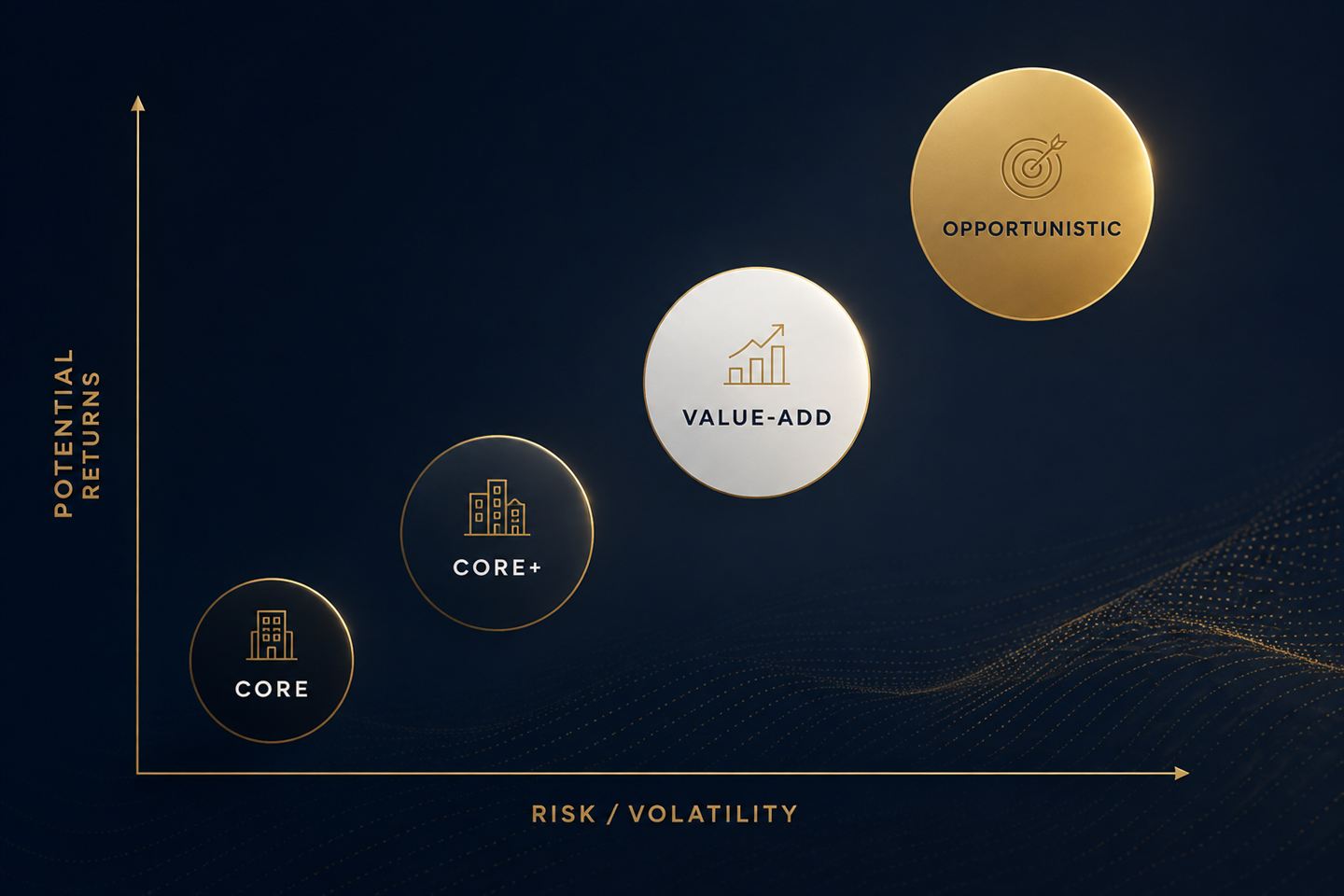
Real estate investing is not one thing. It sorts into four strategies, core, core plus, value-add, and opportunistic, each with its own risk, leverage, and target return. Core is the steadiest, opportunistic the most aggressive. Knowing where a deal sits tells you what you are really buying.
Here is a myth I run into constantly: that real estate investing is one thing. You buy a building, you collect rent, you wait. If that were true, every deal would carry the same risk, and it very much does not. A stabilized apartment complex leased to long-term tenants and a patch of dirt where someone plans to build a hotel are both "real estate," and treating them as the same investment is how people get hurt.
So before you look at a single opportunity, you need the vocabulary the industry actually uses to sort deals. There are four buckets, and they run from calm and predictable to high-stakes and speculative. Once you can tell them apart, you stop asking "is this a good deal?" and start asking the better question: "is this the right kind of deal for me?"
Why does "real estate investing" mean four different things?
Professionals do not grade real estate on gut feel. They sort it along a spectrum of risk and return, and that spectrum has four named stops: core, core plus, value-add, and opportunistic. As you move from the first to the last, three things climb together. The leverage rises, meaning more of the deal is financed with debt. The uncertainty rises, because more of the outcome depends on execution rather than existing cash flow. And the target return rises to compensate you for taking that on.
None of these is better than the others in the abstract. They answer different questions. Do you want steady income you can rely on, or are you willing to trade certainty for a shot at a much larger gain? The honest answer differs from one investor to the next, which is exactly why the categories exist. Let me walk through all four.
What is a core investment?
Core is the calmest end of the spectrum. Think low-maintenance properties in prime locations, already leased to high-quality tenants who pay reliably. There is little drama here and little to fix. You are buying an established, income-producing asset and collecting the cash flow it already throws off.
Because the asset is stable, core deals lean lightly on debt, usually financed with less than fifty percent leverage. That conservatism is the point. Target annual returns typically land in the seven to ten percent range. You will not get rich overnight on a core deal, and that is not the job. The job is durable income with a low chance of a nasty surprise, which is why core tends to suit investors who prize stability over swing.
What is a core plus investment?
Core plus is the bridge between playing it safe and reaching for more. The properties are solid but not pristine. Maybe the building needs light updates, or it sits in a neighborhood that is on its way up rather than already there. You accept a little more work and a little more uncertainty in exchange for stronger upside.
These deals usually carry fifty to sixty percent debt, a notch above core. Target annual returns run roughly eight to twelve percent, blending steady income with a real shot at appreciation. If core is income first, core plus is income with a growth kicker.
What is a value-add investment?
Value-add is where the strategy shifts from collecting to creating. You buy a property that has an identifiable problem you can fix, an aging apartment building that needs renovation, mismanaged units, below-market rents, and you force the value up through the work you do. The classic small-scale version is a fix and flip. The institutional version is renovating and repositioning a larger asset.
That upside comes with more leverage, commonly sixty to seventy-five percent debt, and more that can go wrong. Budgets overrun, timelines slip, tenants churn during the work. Done well, target annualized returns sit in the ten to fifteen percent range. This is the point on the spectrum where expertise starts to matter a great deal, which is why value-add is generally considered best suited for seasoned investors. Hold that thought, because there is a way in that does not require you to become the expert yourself.
What is an opportunistic investment?
Opportunistic is the deep end. This is ground-up development and other projects that start with little or no existing income, sometimes an empty lot and a plan. There is nothing to collect on day one. The entire return depends on building the thing, leasing it, and stabilizing it, often over a span of years before you see a dollar back.
These deals typically carry fifty to seventy percent debt and demand substantial upfront capital and specialized know-how. In return, they promise the highest payoff of the four, with target returns often exceeding twenty percent annually. They also carry the highest chance of a disappointing outcome. Opportunistic is where the largest wins and the largest mistakes both live.
How do the four types compare at a glance?
Here is the whole spectrum in one view. Read it top to bottom and you can watch the leverage, the return, and the risk climb together.
| Strategy | Typical leverage | Target annual return | Risk profile | What you are really buying |
|---|---|---|---|---|
| Core | Under 50% | 7 to 10% | Lowest | Stable income from an established asset |
| Core plus | 50 to 60% | 8 to 12% | Low to moderate | Income plus modest growth |
| Value-add | 60 to 75% | 10 to 15% | Moderate to high | Forced upside through renovation |
| Opportunistic | 50 to 70% | 20%+ | Highest | A payoff you have to build from scratch |
Targets are just that, targets. They describe the return a strategy is designed to pursue, not a promise of what any single deal will deliver. Higher on the list means more can go wrong, and the return exists to pay you for that risk.
How do you get into deals that seem out of reach?
Notice the trap in what I just described. The strategies with the biggest upside, value-add and opportunistic, are also the ones that reward deep expertise, large checks, and hands-on management. If you had to run those projects yourself, most people would be permanently locked out of the most rewarding parts of the market.
That is the problem syndication solves. In a syndication, a professional sponsor sources the deal, arranges the financing, and manages the execution, while individual investors pool their capital to participate. You get a stake in a value-add or opportunistic project without personally becoming a developer, a contractor, or a property manager. Your role is passive. The sponsor's job is to do the work and earn the return the strategy targets. It is the mechanism that lets a private investor own a slice of a deal that would otherwise sit far out of reach.
Which type is right for you?
There is no universally correct answer, only the one that fits your goals and your stomach. If you want dependable income and you sleep better knowing the tenants are already in place, core and core plus are speaking your language. If you are willing to trade certainty for a larger potential gain and you trust the operator running the project, value-add and opportunistic are built for that trade.
The mistake is not picking the aggressive bucket or the conservative one. The mistake is not knowing which bucket a deal belongs to before you commit. Ask where an opportunity sits on this spectrum, and you will already understand more about its risk than most people who invest in it.
When you are ready to look at real opportunities across all four strategies, this is the work we do at Aurea Equity. We bring AI-scored private real estate deals to accredited investors, deal by deal, so you choose the specific opportunities that fit you. Our Aurea Intelligence Engine scores markets and deals, and then people make the call, because technology supports judgment, it does not replace it. If that sounds like your kind of investing, the door is open.
Frequently asked questions
What is the difference between core and opportunistic real estate?
They sit at opposite ends of the risk-return spectrum. Core means stable, income-producing properties in prime locations with low leverage and target returns around seven to ten percent. Opportunistic means ground-up development or projects with little existing income, higher leverage, and target returns often above twenty percent, along with the highest chance of loss.
Do I need to be an accredited investor to join a real estate syndication?
For the private syndications Aurea Equity offers, yes. Accredited status generally means income over $200,000, or $300,000 with a spouse, in each of the past two years, or net worth over $1,000,000 excluding your primary residence. We verify accreditation through an independent third party.
Can passive investors access value-add and opportunistic deals?
Yes, that is exactly what syndication is for. A professional sponsor sources and manages the project while you invest passively and own a stake. It lets individual investors participate in the higher-upside strategies without personally taking on the development, renovation, or management work.
Does a higher target return mean a better investment?
Not on its own. A higher target return exists to compensate you for higher risk, more leverage, and more that can go wrong. The right strategy depends on your goals and your tolerance for uncertainty, not on chasing the biggest number on the page.
Access opportunities before the market sees them.
Aurea is open to accredited investors. See what is available now.
Apply for Access